
Consentless Advertising: The Unexpected Route to a More Sustainable Campaign
Digital advertising is under pressure. Not only because of privacy legislation or transparency concerns, but also because of a growing awareness of something that stayed out of view for a long time: the CO2 emissions of programmatic advertising. Only a small share of advertisers and agencies measure those emissions or take concrete action.
What is consentless inventory?
When a visitor clicks "reject all" on a website, the ability to use third-party data or serve ads through the usual ecosystem of SSPs, verification services, and analytics platforms disappears. Large media platforms sometimes call on 50 to over 250 advertising partners as soon as consent is given. Without consent, all these partners fall away. What remains is a cleaner advertising environment: one ad call, one server request, no chain of third parties watching along.
By comparison: a consented page view typically generates a series of server requests to ad servers, analytics platforms, verification services, and multiple SSPs for display, video, and native placements. That infrastructure comes at a price, and that price isn't only financial.
Every one of those server requests, every data exchange, every process costs energy. And energy means CO2 emissions. The more partners involved, the more servers have to work, the more energy is consumed. The more energy, the larger the ecological footprint of that single impression.
The question was simple, really: which route is cleaner? A consented open market with many partners and therefore many server requests, or consentless inventory? Our hypothesis: consentless wins on sustainability.
How was this tested?
Omnicom Media and Opt Out Advertising ran a 50/50 split test on display ads. Half of the ads were shown via consented inventory on B2B domains through an omnichannel DSP. The other half were served through the Opt Out DSP, focused entirely on consentless inventory within its premium network.
For the consented variant, CO2 emissions were measured via Scope3. The consentless variant was measured directly through Opt Out Advertising's own servers. Both approaches followed the same measurement standards. By then systematically analyzing domain size and consumption, a fair comparison emerged, centered on one key question: how much CO2 is actually emitted per thousand impressions?
The results speak for themselves
The outcomes were concrete and significant:
- Total open market CO2 emissions: 448 KG
- Average grams of CO2 per mille (open market): 281 grams
- Total consentless CO2 emissions: 148 KG (a 62% reduction)
- Average grams of CO2 per mille (consentless): 108 grams (a 61% reduction)
The biggest savings occurred in the most common display formats: 300×250 and 300×600. The 300×250 format generated 1,182,025 impressions with a CO2PM of 108g, while the same ad format generated 46% more emissions via the open market. We expect an even larger difference for rich media formats, which make more intensive use of servers and data traffic.
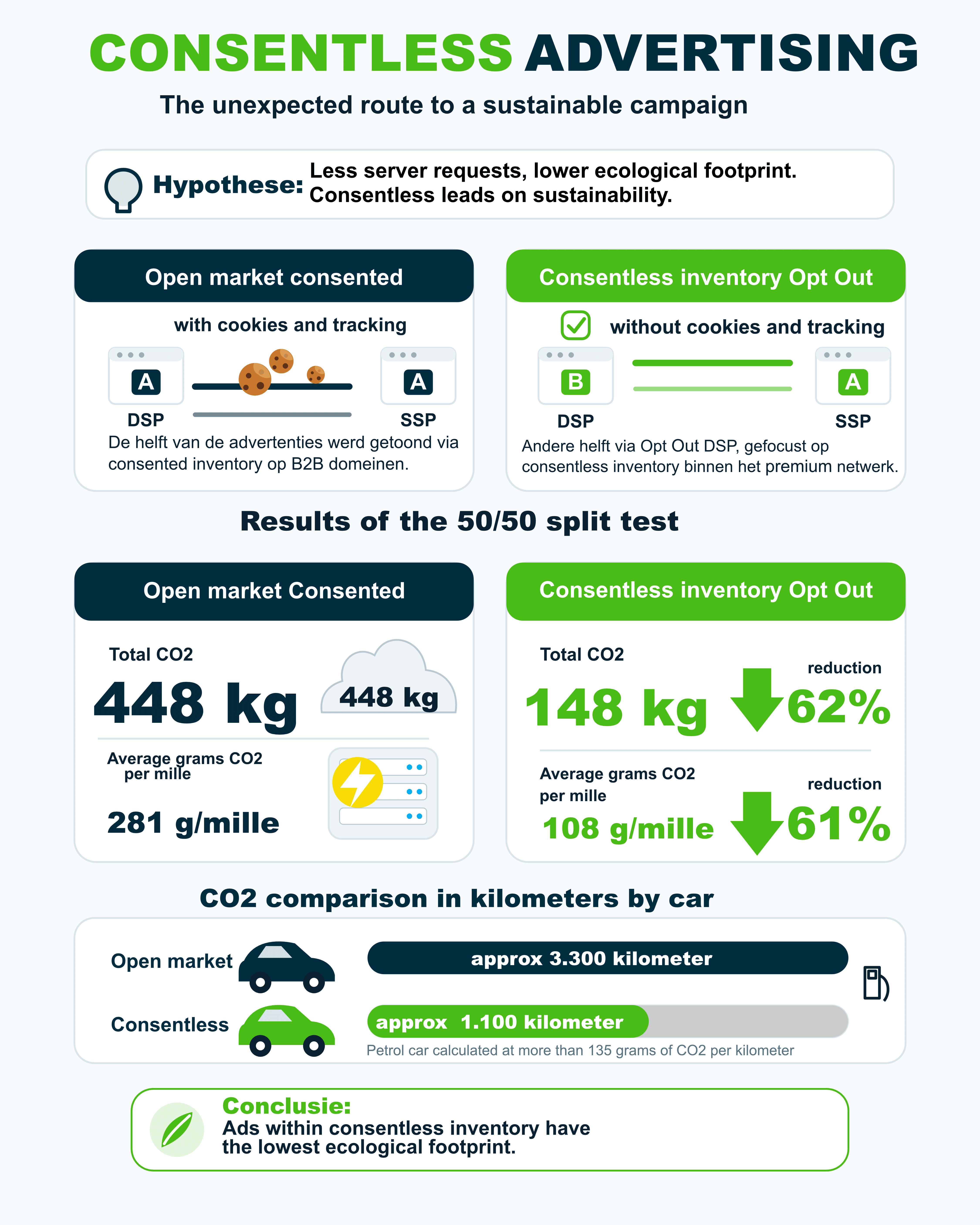
Ads shown within consentless inventory have the lowest ecological footprint.
To put this into perspective: the difference between open market and consentless amounts to roughly 300 KG of CO2. For comparison, that's roughly the difference between driving 3,300 kilometers (open market) versus 1,100 kilometers (consentless) in a petrol car (based on average figures from the RVO, the Netherlands Enterprise Agency). One campaign, two very different ecological footprints.
What does this mean for marketers?
As with transparency in the buying chain, described earlier on Emerce, sustainability within programmatic is becoming an increasingly concrete topic.
Consentless inventory offers an accessible way to lower a campaign's emissions. But it goes further: 80 percent of Dutch consumers say they are concerned about sustainability. By deliberately steering toward domains with a low CO2 footprint and integrating consentless inventory, you don't just make a difference for the climate — you also connect with your audience in a way that reflects what they genuinely value.
This research is a first step, not an endpoint. More data is needed to extend the findings to other channels. But the direction is clear, and that's reason enough to act today: a campaign's technical architecture determines not only the price per impression, but also its ecological impact.
Transparency as a starting point
With this research, Omnicom Media and Opt Out Advertising aim to contribute to a discussion that has been postponed for too long. The invitation is open: to publishers, technology providers, agencies, and advertisers, to build on these findings and help search for a cleaner advertising infrastructure.
The message is clear: anyone who wants to compete in the programmatic market needs to know the rules of the game. And those rules increasingly involve sustainability too. Consentless inventory isn't just a tactic. It's a statement.
About the authors: Olaf Bos is Product Manager Tech Addressable at Omnicom Media, and Stefan Oude Wesselink is Co-founder & Head of Business Development at Opt Out Advertising.